Wednesday, 19 May 2010

Voyage To The Heart Of Matter

So what's missing in the world of science books?  A quick introduction to Multiverse theory?  Nope, old hat.  Hyperbolic Crochet?  Been there, done that.  


A pop-up book about the Large Hadron Collider?  Oh yes.


  When we ran a shop at the Edinburgh Science Festival recently I was tasked with selecting the books we'd stock.  There's a few obvious choices; everything written by any of the speakers for example, and the top 50 or so from our Pop-Sci section in the main shop, but the really fun bit of the job was picking the odd, quirky titles that somebody is bound to buy.  Voyage To The Heart Of Matter was the first book on that list.

It's a bit of a niche title, only eight pages long (well, four really, given the nature of pop-up books), but it's a glorious piece of paper engineering.  It covers every scale, from subatomic structure, through the ATLAS experiment with Brian Cox's "Regulation EU Scale Humans" to....well...everything.  I kid you not, there's a beautifully rendered Big Bang complete with red-shifting galaxies.

It's been a little bit more popular than the publishers expected I think...it's currently out of print, but we're promised a new edition in June 2010.  I know of at least one celebrity endorsement too....the copy we had at the Science Festival was bought by a very lovely kids science author called Lucy Hawking as a present for her dad, Stephen.  That's really cool.

Take a look at it in all its glory at the ATLAS website - you can also pre-order the new edition here.


Voyage To The Heart Of Matter - The ATLAS Experiment at CERN
Anton Radevsky, Emma Sanders
9781906506124

Wednesday, 5 May 2010

Dave Halliday, 1916-2010

I cracked a bit of a gag with our rep from Wiley publishing today along the lines of "David Halliday is coming round later to highlight some of his books".  It's a gag because Dave Halliday's book Fundamentals Of Physics is probably one of the best selling and most comprehensive physics textbooks on the planet, and having it highlighted by the author is probably the best possible way of returning it to the publisher for a refund with no questions asked.

Turns out that it's not all that funny at the moment, because Dave Halliday, physics textbook god and all round nice bloke by all accounts, died a couple of weeks ago.

Aly from Wiley was nice enough to copy me in on an internal company memo.  Dave (as I'll refer to him, as I feel like that) was clearly a person who Wiley, as a company, had a great affection for.  It had less to do with his best selling textbook, and far more to do with the fact that he clearly had a great passion for physics and just as great a passion for communicating it.  I agree...Fundamentals was the one big purchase I made as an undergraduate, and also the one book I've made a point of keeping.  In fact, I've currently got two copies, because at some point the version with the lovely essay covering the Leidenfrost effect was cancelled, and a customer in the shop was good enough to make a point of donating one to me on hearing my laments at losing it.

Dave was a proper physicist in all respects, both the practical (he worked on radar systems in WWII, placing him alongside Arthur C Clarke and Isaac Asimov), and the theoretical...his books were never afraid to nudge the side of science fiction that invariably becomes true given enough time.  By far my favourite suggestion in the book is that final degree exams should be replaced by a firewalking exercise, carrying a copy of Fundamentals under your arm, the idea being that if you believe in physics enough to walk across hot coals, and you believe enough to know just how much it could hurt if it goes wrong, then you deserve a degree.   Then again, I'm biased because I've not got a physics degree and I'd happily carry a copy of Dave's book over hot coals just on principle.

There's a lovely picture that sums up his attitude towards books, and hopefully I'll get permission to replicate it here....it's him alongside a manuscript for a recent edition of Fundamentals.....and he's only slightly taller that the stack of A4.

If you want a comprehensive undergrad level book on physics then buy "Halliday, Resnick & Walker's Fundamentals Of Physics".  If you don't, then please remember David Halliday's name, he's inspired umpteen numbers of physicists who will change the entire universe in the long run.

Tuesday, 20 April 2010

The Edge Of Physics

There's a fairly standard format for popular science books, especially ones dealing with maths or physics:

  1. Say something which on the face of it sounds ridiculous and counter-intuitive.
  2. Go back in time to the person or people who discovered the theory.
  3. Very carefully go through the theory, step by step, in a way that's hopefully comprehensible to the laymen.
Anil Ananthaswamy takes a very different and refreshing approach in The Edge Of Physics.  If you've never heard of neutrinos, the cosmic background, or dark matter then this might not be the best book to start with.  There are explanations of all three, but they're relatively cursory and jump fairly quickly into the meat of the book - a round-the-world trip covering every continent and visiting some of the biggest and most audacious experiments currently being attempted.

It's a refreshing change - this is a very real look at the people who are currently sat in high altitude deserts, or freezing cold icecaps, or anywhere else that counts as remote and inhospitable, and the outrageously big, expensive and precise machines they're using to probe space and time.  You're just as likely to find accounts of the physicist's favourite drinking games and running jokes as you are an explanation of what neutrino oscillation is and why it's important.  It's a book that's very much about the human side of the experiments, the dangers, the Heath Robinson solutions so often employed and the humour that has to go hand in hand with jobs that are as far removed from the dusty, dry popular perception of theoretical physics as it's possible to get.

The LHC, the current poster-boy, get a good going over, as does the far more established (by a century or so) Mount Wilson observatory.  The part I particularly enjoyed was the coverage of two of the biggest neutrino telescopes in the world, one suspended in the depths of Lake Baikal and the other embedded in cubic kilometres of the Antarctic ice cap.  

This is a book that's not only to be applauded, but even made into a very cool TV show.

The Edge Of Physics
Anil Ananthaswamy
Duckworth Overlook 
ISBN: 9780715637043

Tuesday, 13 April 2010

Edinburgh Science Festival 2010

Wow.  The Edinburgh International Science Festival has always been a bit of a big deal, but this year is noticeably bigger and better than previous years.  There's a huge range of events on, from kid friendly talks involving bangs and smells to lectures on exactly why E=mc^2, and everything in between...and then some.

My colleague Ann and I are running a bookshop in the Big Ideas venue, very tolerantly hosted by Edinburgh University's Informatics Forum, and our sales seem to show a few interesting things about the book-buying public's interest in science.  Now whilst we're selling books tailored to each event (usually written by the speakers) it's a wide ranging sample of titles - the selection is dominated by our popular science section from the local shop, plus a proportional selection of the more advanced stuff...for example Jeff Forshaw was nice enough to sign a copy of Dynamics And Relativity for me.  This is (L->R) me, him, Ann, Jeff's sidekick Brian, Ben and Imran.  The ones who aren't professional particle physicists are me and my geekier colleagues.


It's become very clear however, that there's two big things catching the public imagination.  The big sellers subject-wise are physics (particularly the extremes of relativity/cosmology and fundamental particle physics, which join up at the back in a very Eddie Izzard way) and psychology/psychiatry.

Brian Cox and Jeff Forshaw's Why Does E=mc^2 is unsurprisingly the number one given both Prof. Cox's current renown and the fact that it's an excellent book, but it's very closely followed by Antimatter by Frank Close, a bit of a surprise hit considering it's always been a bit of a constant but slow burner in our main shop.  (There's a pretty cool Blackwell podcast about it here,)

Marcus Chown continues to be a big seller, initially heading the leaderboard, with in my opinion some of the best popular physics books going, and ones that aren't afraid to tackle the more controversial and wacky (read "interesting" in my book) topics like Multiverse theory and alternatives to accepted theories.

On the psych side Kathleen Taylor's Cruelty has been very popular, and out of nowhere the diametrically opposed Stumbling On Happiness by Daniel Gilbert has been so keenly and unexpectedly snapped up that we've had to beg steal and borrow copies from all over the UK just to keep it on the shelf.  Ian Deary has also been incredibly prominent, particularly his Intelligence: A Very Short Introduction.


And to finish, there's a few odd little titles that deserve mentions.  Daina Tiamana's Crocheting Adventures With Hyperbolic Planes is the quirky hit it deserves to be, especially with some of the speakers.  The guys from the LHC really enjoyed the masterpiece of paper engineering that is Voyage To The Heart Of Matter, clearly the best pop-up book about the Large Hadron Collider ever created.  (EDIT: Full review here)

And there's no way to sign off from an Edinburgh SciFest report without special mention to the Edinburgh Geological Society for their superb collection of publications, particularly Building Stones Of Edinburgh (which suffers from a fairly prosaic title when it's a far more interesting book than it sounds) and Discovering Edinburgh's Volcano (which suffers from only being £1.50 when it's easily worth more).  As an aside, I'm kind of proud of pushing EGS titles given the fact that Edinburgh is pretty much the birthplace of modern geology....buy their books (ideally directly from them) and support a great local amateur society.


The Big Ideas venue deserves a mention in its own right, the combination of a science festival, bookshop and cafe has created a pretty cool space that has developed a real buzz; I've had some fascinating chats with a mountain biking maths teacher called Karen, a physics prof who wanted to know why I'm in to physics ("Sheer curiosity, if you ask 'but why?' often enough you get to physics..." was my honest answer), and a whole legion of volunteers working some silly hours for free just because they're geeks and damn proud of it.

There's still a weeks worth of events left....see you there!

Friday, 26 March 2010

Crocheting Adventures With Hyperbolic Planes - Diagram Prize Winner 2009


Hooray!

A well deserved win for Daina Taimina and her lovely book covering the representation of non-Euclidian geometry with crochet and knitting.

Get your copy here:

Blackwell Online (UK based, the company I work for)
A K Peters (US based publishers of the book)


Or (ideally), put the keyboard down, go outside and buy a copy in your favourite local bookshop. :)

If you're Edinburgh based we'll have copies on sale at our Edinburgh Science Festival bookshop in the Informatics Forum on Potterow.

Tuesday, 23 February 2010

Diagram "Odd Titles" Award 2010

The Diagram Prize is probably the most prestigious and sought after award in publishing.  Probably.  


It's organised and presented by the infamous and highly respected Horace Bent, a time served Old Skool publishing journalist at The Bookseller, the UK's main trade magazine.  The award is given to the book (and it has to  be a real book, none of this short-run self published three copies ever bought nonsense) with the oddest title.


This year's shortlist is:


  • Afterthoughts of a Worm Hunter by David Crompton
  • Collectible Spoons of the Third Reich by James A Yannes
  • Crocheting Adventures with Hyperbolic Planes by Daina Taimina
  • Governing Lethal Behavior in Autonomous Robots by Ronald C Arkin
  • The Changing World of Inflammatory Bowel Disease by Ellen Scherl and Maria Dubinsky
  • What Kind of Bean is This Chihuahua? by Tara Jansen-Meyer


All great and worthy entries I'm sure, but there's really no substitute for voting Crochet.  My reasoning, in the spirit of the competition, is thus:


The superb juxtaposition of relativistic equations and traditionally feminine handicraft skillfully blend against a backdrop of four dimensional hyperbolic space utilising the three dimensional creations of a wool based algorithm in a context of knot theory and non Euclidian geometry carrying a sublimely fundamental and yet simultaneous intimate and accessible viewpoint on the structure of the Universe which opens the mathematical structure of spacetime to the casual ovicentric hobbyist.


*DEEP BREATH*


The meta-historical setting of a rural craft invokes powerful images of Einstein's modest upbringing in combination with the sub-metaphorical emotional influence of handmade knitwear leading to a subconscious acceptance of the incongruity self evident in the utilisation of a folded two dimensional yarn construct attempting to represent a geometry including a mathematically imaginary component. 


Vote Crochet, you know it makes sense.


In all seriousness, I'm shamelessly pushing this book as a winner because it's a superb book on an astoundingly beautiful subject, both in terms of mathematics, physical theories and handicraft.  In laymans terms it covers (mostly from a crochet/knitting point of view) the stunning results of writing the equations behind General Relativity into a knitting pattern.  It's not as silly as it sounds....knitting patterns are effectively computer programmes for a single strand of wool, and as such are ideal for trying to demonstrate a mathematical idea.  Einstein's theories deal with the idea of treating time as a fourth dimension....but there's no room for one in high school maths.  So he tried using imaginary numbers - ones based on the square root of minus one, and commonly shown on a graph at right angles to "normal" numbers - his little thought experiment turned out to be such an accurate description of reality that the theory has to be hard-coded into GPS satellites to stop them going out of synch by several metres a day.  
This book takes the simple but highly imaginative step of trying to show Einstein's fourth dimension by writing it into a knitting pattern.  The results are extraordinarily beautiful, closely resembling coral reefs.  It's a great coffee table book and conversation starter, odd title aside.  


You can vote for your favourite at The Bookseller website.  (Scroll down, poll on the left)

Sunday, 14 February 2010

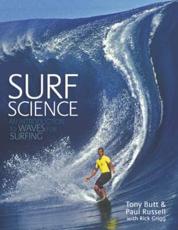
Surf Science

Science has, on occasions, been described as both "dry" and "boring"...two words that are not generally linked to surfing in any way.  Pitched firmly in the middle of the science-curious surfer, or the surfing scientist, this is a great general exploration of the science behind wave formation, from large scale meteorological effects to the very local beach structure and wind effects.

Sadly it doesn't go into much depth concerning the hydrodynamics and technology that actually lets you ride the things, but that's probably a hugely technical step to take with what is, in essence, a highly specialised popular science book.  If you're a nautical type of any description, surfer, kitesurfer or sailor, there's plenty in this that will grab your interest.


Surf Science 
Tony Butt, Paul Russell, Rick Grigg
Alison Hodge Publishing
ISBN: 9780906720363