Tuesday, 12 October 2010

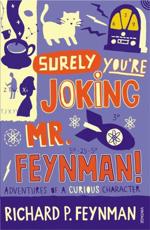
Surely You're Joking, Mr. Feynman!

Richard Feynman, in case you've not heard of him, was a theoretical physicist who worked at Caltech for many years, formulated large parts of modern quantum theory, and was heavily involved in the Manhattan Project, developing the first atomic bomb.  He was also a tad eccentric.

This book is a compilation of many taped discussions he had with friend Ralph Leighton, and they offer a thoughtful and often hysterically funny insight into the mind of one of the great 20th Century physicists.  There's no real structure to the book, beyond being roughly chronological, it's more of a long series of anecdotes about Feynman's personal life, work and views on life, the universe and everything.  There are tales of his sideline as a bongo drummer, black eyes picked up in some disreputable bars, rants about the idiocy he found in the military and the government, lessons in being a bloodhound and some particularly evil practical jokes.

His safe-cracking exploits are particularly funny, as he recounts repeatedly breaking in to the (supposedly top secret) filing cabinet and then safes at the military base hosting the Manhattan Project.  After developing a reputation as somebody who could get into any safe on the base he finally demonstrated that even the commanding officer's wasn't secure by breaking into it in front of him.  This led, not to improved security as you might expect on a military base, but to a standing order that Professor Feynman was not to be left alone with a safe.

There are thoughts on physics in there, but this isn't really a physics book, it's a wonderful window into the mind of one of the great eccentric geniuses of the last century.

It's one of several compilations of writings and recordings: see also What do you care what other people think? and Don't you have time to think?, on top of his bestselling and more technical Feynman Lectures On Physics.


Surely You're Joking, Mr. Feynman!
Ralph Leighton & Richard Feynman
CCV Publishing
ISBN: 9780099173311

Sunday, 5 September 2010

Subject Poll Results

 So the results are in - physics and cosmology take the win, closely followed by maths and history of science.  So you'll probably see more of that in the future.  (Weirdly the last review of Music Of The Primes covered all three quite nicely, pure coincidence I promise.)

That doesn't mean I'm going to ignore biology or psychology though - the reviews are mostly books I've read recently, or dredged up from my last 30 years of reading.  

Tuesday, 31 August 2010

The Music Of The Primes

A two, a three, a two, three, five, seven...

It's how Reimann's band's drummer would have counted in....

No?  Oh come on, that was funny, I spent ages on that.  No?  Really?  Oh well.

Rest assured, Marcus du Sautoy's The Music Of The Primes is far more entertaining than my geeky half-jokes.  Don't get me wrong, there are geek-jokes galore in there, mostly from original sources such as the angry young man that is Galoise, or Gödel's startled pigeon, and that's the great strength of this popular mathematics book, the life it breathes into the world of mathematics.

Not only mathematics, but a very specific area of it, prime numbers.

Prime numbers seem innocuous at first glance, a little mathematical oddity that everybody learns about at primary school.  du Sautoy throws us straight in at the deep end with Reimann and his jottings where he, in passing, has an idea about the frequency of prime numbers.  This idea is one of the big ones...in fact, with the recent fall of Fermat's Last Theorem (see the excellent book with the same title by Simon Singh) and the PoincarĂ© Conjecture, the Reimann Hypothesis is probably the biggest, baddest, longest standing problem in mathematics.  There's still a million dollar bounty out there, if you fancy your chances.

I wouldn't though, it's driven at least one person to madness, and taken a few to the borders.  It's the stuff that techno-thriller spy movies are made of (literally, see Sneakers) and has been implicated in at least one fatal duel and one national revolution.  It's been the subject of, and I kid you not, two Nobel Prize level practical jokes.  If the Reimann Hypothesis is a film character it's dangerously close to being Sherlock Holmes crossed with James Bond.

That's just my reading of the vivid world that du Sautoy paints, the human backdrop to a mathematical enigma that has floated around teasing humanity for over a hundred and fifty years, and counting.  Your mileage may vary, your cultural reference points may differ, but you'll still be left with a gloriously alive vision of the whole mathematically sordid affair.

The Music Of The Primes
Marcus du Sautoy
Harper Collins
ISBN: 9781841155807

Friday, 11 June 2010

In The News: Solar Sailing

When you're a child, and a bit of a geek child at that, you have visions of the future.  Robots that act like humans.  People living on other planets.  Flying cars.  You know, the usual.

Sadly, the future all so often turns out to disappoint.  Yeah, we got mobile phones, big deal.  Shuttle is being retired, Concorde is no more, and frankly I can't put it any better than by referencing the excellent Edinburgh based band "We Were Promised Jetpacks"

Sometimes though, just sometimes, something happens that makes you realise that 2010 isn't entirely rubbish.  OK, we never quite did the Jupiter thing as promised by Arthur C Clarke, but by Jove we've gone and done the next best thing....

The Japanese IKAROS (Interplanetary Kite-craft Accelerated by Radiation Of the Sun) project has successfully unfurled a solar sail, a form of space propulsion most famously predicted in Clarke's lovely short story A Wind From The Sun.  I'm trying to get permission to reproduce the images here, but in the meantime you can find the originals at the IKAROS blog (english language translation, sans pictures, here)


Solar sails are seriously cool.  The idea is that when a photon bounces off a surface then it imparts a tiny amount of momentum.  You can use this force to power a spacecraft without using any fuel whatsoever, except a beam of light. This could be a ground based laser if you want to be all high-tech and efficient about it, but good old fashioned sunlight works just as well.  The only snag is that you need a big sail...a really big sail.  A twelve square metre kite will happily lift me off the ground, so that's a force of about 1000 Newtons, but solar sails aren't that efficient.  A solar sail several square kilometres in size will only provide a few Newtons of thrust.


But that's constant thrust, all the time, 24 hours a day.  Give it a few weeks and you're doing thousands of miles an hour.  Ten years and you're doing millions of miles an hour.  When it comes to interstellar travel, covering light years, that's a far better bet than the old fashioned, fuel carrying, excessively heavy chemical rockets we're using at the moment.  Ion engines are better, and currently being used, but they're still nothing compared to solar sails when it comes to interstellar travel.


Anyway, books are the point of this blog....


Firstly, if you haven't already, you should really read Arthur C Clarke's A Wind From The Sun.  It's just a little short story, included (along with the titular precursor to 2001: A Space Odyssey) in The Sentinal, a great collection of short works and novellas from an acknowledged grand master of sci-fi.


For a more modern version, including a description of a mission to a star and (importantly) actually getting back again, there's Charlie Stross's Accelerando, as also covered in my recent science/sci-fi post.  Stross also deals with the idea of using a ground based laser rather than sunlight, a logical next step from Clarke's concept.


And if you want to get really technical, there's the hefty but relatively cheap (for what it is) Solar Sailing: Technology, Dynamics and Mission Applications by Colin Robert McInnes, a comprehensive study of present and near future technology, science and, as the title suggests, applications of solar sailing.  The character development and plot aren't up there with Clarke and Stross, but we'll forgive that for the sheer depth of knowledge and the fact that Springer Publishing have been nice enough to make huge amounts of it available free on Google Books.

Tuesday, 8 June 2010

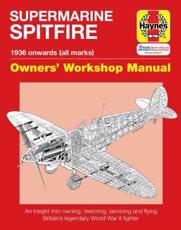
Haynes Spitfire Manual

There are two kinds of people in the world, those who have owned a Haynes Manual and those who haven't.  Haynes are firmly entrenched as the manual to own if you ever get your hands dirty fixing a car or motorbike.  Whether you just want to learn how to change a tyre or oil filter, or if you're a professional mechanic, or even a classic car restorer, Haynes are the benchmark.  They're written by stripping a car down to each individual nut, bolt and shim and rebuilding it, you can't really get a more comprehensive guide.

A few years ago they started branching out a little, producing some titles that weren't really within the original remit.  One of the first was a guide to the male human body, a slightly tongue in cheek reference to the fact that many men look after their cars more carefully than their own bodies.  This particular manual is like nothing else though - the Haynes Supermarine Spitfire Manual (1936 onwards, all marks)!

I can't imagine anyone reading a blog about science books doesn't know all about the Spitfire, the legendary British WWII fighter.  Whilst the Hurricane outperformed it in many ways the Spitfire is the one that still features in every boy's dreams.  A Rolls-Royce powered single seat aircraft that is pretty much the pinnacle of pre-jet military aircraft.

Given the situation they were built in - a resource stripped rush, and mostly under wartime secrecy - there isn't an extant all-purpose engineering manual for them, and Haynes haven't tried to produce one.  Instead this book is aimed more at the small but enthusiastic group of modern day restorers.  Most of the parts are no longer available, and there are only a handful of surviving aircraft, so much of the manual is devoted to the professional and garden shed attempts to replicate the parts that are needed to keep a seventy year old machine airworthy,  There are glimpses into both the engineering behind the original and the modern day devotees who ensure that a beautiful machine can still occasionally be glimpsed in British skies.


Haynes Supermarine Spitfire Manual
Alfred Price, Paul Blackah
Haynes Publishing
9781844254620

Tuesday, 1 June 2010

Alex's Adventures In Numberland


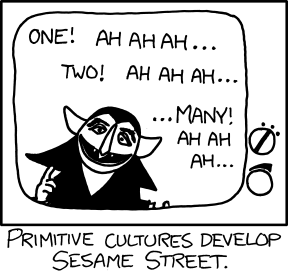
Pic courtesy of the utterly wonderful xkcd

"One, two, many..."
Anon

You're probably thinking of one of two things here.  Either some deep-Amazon tribe you vaguely remember hearing of that can't count past two, or if you're like me then you're thinking of Detritus the troll in Terry Pratchett's wonderful Men At Arms.

What does this have to do with Alex Bellos' fun new book?  Well, he's in the first camp, and does a great job of filling in the details on what I'd always thought was maybe something of an urban myth.  Tribes who don't count past two(ish) do exist, and it's not as simple as you'd think - sometimes you simply need "a few", we still do in the western world most of the time, "ish" is probably used more often than exact numbers in everyday life, and for good reason.  Bellos uses this as a starting point for a popular maths book that doen't so much look at maths as an abstract subject but concentrates on how humans use, misuse and interact with it.

Each chapter covers a different area of maths - series, probability and geometry for example - and delves into the human side of them.  We all remember Pythagoras' Theorem from school, but how many know about the hundreds of different amateur proofs over the years?  How did a skewed bell curve get a Parisian baker into a fight with the mathematician Poincare?  Is there any point to the continued efforts to calculate Pi?

This is just as much a study of human psychology in relation to numbers as it is a book about maths, and all the more entertaining for it.

EDIT: And it also inspired a little bit of 3D modelling with Blender....


Alex's Adventures In Numberland
Alex Bellos
Bloomsbury
ISBN: 9780747597162

Sunday, 23 May 2010

Science Fiction, Sci-Fi and SF

As the blog title suggests, I'm not adverse to including a little science fiction in my definition of science.  It's a fuzzy boundary, especially when either discipline is done well, and as we know from chaotic systems like the Mandelbrot set, the fuzzy boundaries are the interesting bits...


And buried in there somewhere is the reason I'm a terrible sci-fi snob.  Sorry, but there's a side of me who always pretended to be Spock rather than Kirk when we played Star Trek, and he insists on the proper science thing.  Snobs like me make distinctions between sci-fi genres, and the only real, pure form to a geek of my sensitivities is "Hard" sci-fi.  Not soft csi-fi, not space opera, not fantasy, and definitely nothing whatsoever involving Dan Brown.   

It's all terribly precious and highly strung.

In most definitions of hard sci-fi any semi-magical futuristic events have to have a proper explanation according to the scientific thought at the time, or at least have a good stab at it.  That's where Star Trek, in my opinion, falls into the space opera category.  If you're going to base a faster than light drive on Einstein's model of spacetime then please have the decency to respect the other 60% of the theory and deal with the time dilation effects.  Honestly, it's not only lazy, it's all a bit 1920s isn't it?

Sorry.  Like I said, it's an emotional issue.  

The point is, the best science always involves an element of really good science fiction, and vice versa.  This is my pick of some great science fiction, roughly married to a good book for background reading....